← Back to Blog
AI ToolsMusic Production

The Best Audio to MIDI Converters in 2026, Ranked

John von Seggern
John von Seggern

Founder & CEO, Futureproof Music School
The Best Audio to MIDI Converters in 2026, Ranked

Last updated August 2026. Next review: September 2026.

If you want the short answer: start with NeuralNote, which is free, and if it does not work for your material no paid tool is likely to rescue you.

That sounds flippant. It is the actual consensus. Across every producer forum we read, the thing that decides whether audio to MIDI works is not which tool you buy, it is what you feed it. A clean single-note line converts beautifully in almost anything, including the free options. A chord, a strummed guitar, or a full mix degrades sharply in everything, including the $399 one. No tool on the market outputs directly usable MIDI from dense polyphonic material, and on that point we found zero dissent anywhere.

So this guide is organised around your source material rather than around a leaderboard, and it answers the question that everybody asks and nobody has answered: what is actually best for polyphonic audio.

How we researched this

We did not test these tools for a weekend and write up an opinion. Conversion accuracy swings enormously by instrument, by how clean the recording is, and by how many notes are sounding at once, so one person's test on one file tells you very little.

Instead we aggregated what people who use these tools daily report. For this article that meant reading around 40 full discussion threads across r/edmproduction, r/musicproduction, r/audioengineering, r/ableton, r/Logic_Studio, r/cubase, r/Reaper, r/Bitwig, r/piano and r/transcribe, plus the relevant threads on Gearspace, VI-Control and KVR, and every comparison video we could find with its comment section. The evidence runs from 2022 to August 2026, weighted heavily toward the last twelve months. Everything is listed at the bottom.

Three standing commitments:

  • Every price and every feature gate here was checked against the vendor's own page on 4 August 2026. That matters more than usual in this category, because two of the "cheapest way in" claims that circulate widely are simply false, and we will show you which.
  • We report disagreements as disagreements, and this topic has real ones.
  • We check sponsorship. In this category it predicts the winner of a comparison almost perfectly.

This article is reviewed and updated monthly. Tools here have shut down, changed pricing model, and changed prices on the day we published, so a stale guide is actively misleading.

First, the thing that decides everything

Audio to MIDI is not one problem. It is three, and they have very different success rates.

Monophonic material: solved. One note at a time, cleanly recorded, not much reverb. A bassline, a sung melody, a lead synth line, a DI'd guitar solo. Nearly every tool handles this, and the free ones are competitive with the expensive ones.

Polyphonic material: not solved. Chords, strummed guitar, piano with both hands, anything where notes overlap. Every tool degrades here, and the honest range of outcomes is "a useful starting point you will spend time correcting."

Full mixes: historically, do not. Separate the stems first, and even then expect to work. This is the one part of the picture that changed in July 2026, and we cover the tool that changed it below.

The technical reason is worth understanding, because it explains why this will not be fixed by a better product next year. A note played on a real instrument contains harmonics: play A3 and you also get energy at A4 and E5. As one producer put it on r/audioengineering, did you play one note with two harmonics, or three pure sine waves? Without further context no algorithm can tell, because the two are literally the same signal. Add the fact that reverb tails make note endings ambiguous, and you have a problem that is genuinely hard rather than merely unsolved.

One consequence shows up in every thread: pitch is rarely what fails. Note timing and velocity are. Converted MIDI tends to have roughly the right notes with wrong start and end points and flat, robotic velocities. Budget your cleanup time there.
NeuralNote and Spotify Basic Pitch: start here, and they are free

These are the same thing in two wrappers. Spotify released Basic Pitch, an open-source polyphonic transcription model, under an Apache 2.0 licence. NeuralNote wraps that model in a free plugin that runs inside your DAW, which is how most producers now encounter it.

NeuralNote is the default free recommendation across the community by a wide margin. It is the first or second answer in nearly every 2026 "free audio to MIDI" thread, in Cubase, Bitwig, Reaper, Logic, Ableton and Linux subs alike. A representative Logic thread called it "much better than Logic's, and is polyphonic." A Cubase user said he normally uses VariAudio, "but sometimes it can be too sensitive and takes a lot of work to clean up the MIDI. That NeuralNote plugin is much simpler."

The criticism is equally specific and worth knowing. It applies pitch bends that can make the output sound out of tune until you strip them. Clean, simple recordings convert well and real expressive playing tends to break it. One user reported a straightforward bass track converting terribly. And structurally, it pools everything into one undifferentiated result with no tempo grid, so you need to know your BPM going in.

Two practical gotchas that cost people time: the export defaults to 120 BPM, so the MIDI arrives at the wrong tempo unless you fix it, and there is no real-time mode despite what some tutorials imply.

Basic Pitch's hosted web demo is still live and processes audio in your browser without uploading it. Worth noting for the maintenance-conscious: the last code push to the repository was November 2025, so this is stable rather than actively developed.

Price: free. Both of them.

Mirelo and MuScriptor: the one genuinely new thing here

Everything else in this guide converts one part at a time. In July 2026 Mirelo, working with the research lab Kyutai, released a model that attacks the problem everyone else avoids: give it a finished stereo mix and it returns a separate MIDI track per instrument, labelled, plus chords, key and tempo. No stem separation step.

That is a different capability, not an incremental accuracy gain, and it is worth being precise about the distinction. Nobody is claiming Mirelo beats Melodyne at converting a clean monophonic bassline. What it does is the thing that until now required separating stems first and then converting each one, with instrument identity lost along the way.

The research model, MuScriptor, is open and its numbers are published, which is more than any commercial tool in this guide offers. It is a 1.3 billion parameter transformer, and on a 372-track test set it scores an onset F1 of 60.4, frame F1 of 72.4, and a multi-instrument F1 of 47.8. Read those honestly: they are meaningful for a task nothing else attempts, and they are nowhere near a clean transcription. It had roughly 3,900 downloads in its first month.

The model card is unusually candid about limits, and they line up with what producers report everywhere else in this article: it cannot represent velocity or dynamics at all, its training data skews to pop and Western classical, it cannot represent two identical simultaneous pitches on the same instrument, and rare instruments and underrepresented genres transcribe less reliably. One producer who ran it self-hosted found it excellent on basslines, harmonies and counterlines, with unreliable instrument assignment and mangled woodwind runs.

Two licensing points that matter more than the price. The open MuScriptor weights are released under CC-BY-NC 4.0, which is non-commercial. If you are converting a mix into MIDI for a track you intend to release or sell, the open model is not the route. Mirelo Studio, the hosted product, is the commercial path and runs a larger training set than the open release.

Mirelo Studio prices in euros, not dollars, which is worth flagging since every other price in this guide is USD. The free tier gives 5,000 credits a month against a rate of 2.5 credits per second of audio, so roughly 33 minutes of conversion a month, with watermarked exports, a three-project cap, and projects deleted after a week. Creator is €20 a month for about 160 minutes. Studio is €99 a month.

Our read: this is the most interesting thing to happen in this category in years, and it is also brand new, which means the community evidence that this guide is built on barely exists yet. Treat the capability as real and the accuracy claims as unproven until more producers have run it on their own material. We will have a much better answer at the November review.

Melodyne: the incumbent, and the pricing trap

Melodyne is still the most-named tool in this category, and its reputation is well earned for monophonic work. "For single notes at a time, it is the best solution in my opinion" is a fair summary of the consensus, and it remains the most reliable choice when accuracy on a single line matters.

On polyphonic material the community has turned against it, and this is the best-supported negative claim in our entire research corpus. From r/HybridProduction in May 2026: "People have said Melodyne is the best, but it's still kind of awful, especially on polyphonic mode. Which 90% of the time is what you want it for." A Reaper user measured roughly 70 to 80 percent correct note placement on jazz chords. On VI-Control, a user re-scoring the same piano piece rated Melodyne 5 to 10 percent usable against 85 to 95 percent for two newer tools.

Recurring complaints beyond accuracy: no ARA support in Ableton or Logic, which people call a bigger problem than the dated interface, plus overtone and ghost-note pickup and unreliable velocity output.

Now the pricing trap, and this is the single most useful thing in this article. Roundups routinely list Melodyne at $99 as the affordable entry to audio to MIDI. That is wrong twice over:

Edition Price Audio to MIDI? Polyphonic DNA?
essential $99 No No
assistant $249 Yes No
editor $399 Yes Yes
studio $699 Yes Yes

Melodyne essential cannot export MIDI at all. The cheapest edition that converts audio to MIDI is assistant at $249, and the cheapest that handles polyphonic material is editor at $399. There is an unrestricted 30-day trial, which starts as studio, so you can find out what you actually need before paying.

The DAW you already own

Before buying anything, check what is already installed. The answers vary more than you would expect.

Ableton Live's Convert to MIDI is the most complained-about tool in the category, to the point that the flagship thread is titled "Why, in 2026, is Audio to Midi on Ableton so bad?" The most upvoted technical answer in that thread is fair-minded: the problem is hard, and "even using something like Melodyne, which is extremely accurate, more accurate than Ableton, it's often wrong." Opinion splits roughly evenly between "it works if you clean up" and "not worth the cleanup."

Its Convert Drums function has a specific defect worth knowing before you rely on it: it only maps to three notes. Everything becomes kick, snare, or hi-hat. Cymbals get mapped as hi-hats and toms get mapped as kicks. Ableton's own manual is honest about this, saying it attempts to identify kick, snare and hi-hat sounds.

And a gate that guides get wrong as often as the Melodyne one: Ableton Intro at $99 does not have audio to MIDI. Ableton's own edition comparison marks it absent in Intro and present in Standard and Suite. The cheapest Ableton that converts audio to MIDI is Standard at $349.

Logic Pro converts monophonic audio well enough through Flex Pitch, and the method people actually use is to duplicate the track, flex it aggressively, then convert. On chords it is consistently described as borderline unusable. One producer's line is too good not to quote: "Logic keeps trying to turn my acoustic arrangements into the EDM track of the summer."

But Logic users are sitting on a better path that many of them do not know exists. The Chord Track and Chord ID, added in early 2026, analyses chords from an audio region directly. As one user explained it, drag any audio region up to the Chord Track, let it analyse, then drag the chord region back down and you have chords as MIDI. Several people in that thread had no idea. If you want harmony rather than individual notes, this is faster and more accurate than Flex Pitch.

Cubase VariAudio is quietly the best DAW built-in, per the one direct comparison we found: better than Ableton, slightly behind Melodyne. It is monophonic in practice, Pro edition only, and the path is buried (double-click the clip, enable VariAudio, then Functions, then Extract MIDI). Cubase users themselves report poor results on solo piano, which is consistent with it being a monophonic tool.

Reaper's ReaTune is the sleeper: free, built in, outputs MIDI notes, and gets recommended repeatedly for guitar and voice.

Bitwig has no native audio to MIDI at all. The community answer for Bitwig users is NeuralNote. It does have transient-based slicing and Replacer for drum work.

FL Studio has Newtone for pitch editing and Edison for pitch detection, but neither is really a transcription tool. The one substantial FL thread on this is titled "how to fix this mess FL Studio created," and the top answer is to fix it by hand.

AnthemScore, and the tools built for one instrument

AnthemScore placed second in the only independent multi-tool shootout we found, beating a well-marketed newer competitor on polyphonic acoustic guitar. It is a desktop app aimed at producing sheet music, and it is repeatedly singled out as unusually good at bass.

Its pricing has the same trap as Melodyne: AnthemScore Lite at $29 cannot export MIDI. You need Professional at $44 for MIDI, MusicXML and note editing, or Studio at $110 for batch processing and lifetime updates. It also recently added a web subscription at $9.99 or $29.99 a month, which is new enough that most guides still describe AnthemScore as a purely one-time purchase.

For solo piano specifically, a different set of tools leads. Eldoraudio comes up repeatedly on VI-Control through 2026 as the strongest piano option, including capturing sustain pedal, which neither Melodyne nor the newer commercial entrants attempt. Its founder posts on forums and discloses that he is the developer every time, and volunteers the tool's limits, which is more than most vendors manage. Songscription earns genuine praise for piano-to-notation, with one user reporting it got every note and rhythm right on a Beethoven piece, though professional transcribers in the same threads are far less impressed.

Worth knowing if you are chasing maximum accuracy on piano: the benchmark everyone cites is not a product at all. ByteDance's open piano transcription model is repeatedly described as near-perfect, but it is a Python install from GitHub, and its training-data licence reportedly blocks commercial redistribution. That is a large part of why the best-performing model in this space is not something you can buy.

RipX: great for seeing notes, weak at exporting them

This distinction is the most consistent single finding in our research, and it holds from 2022 through 2026. RipX shows you a beautiful visualisation of every note in a track. Its MIDI export is a different story. A VI-Control user put it bluntly: it looks impressive when it highlights all the notes during playback, "but if you export the actual MIDI notes and play it on an instrument, you realize it's a bunch of garbage." The independent 2026 shootout ranked it last for MIDI specifically, citing excessive pitch bends.

That does not make it useless, it makes it a different tool. Learners genuinely love it for studying parts on screen, and its stem separation is strong. Just do not buy it primarily for MIDI export. RipX DAW is $99 and PRO is $198, both currently 25 percent off in a summer sale.

Samplab is shutting down

If you find a tutorial recommending Samplab, it is out of date. Samplab has posted a wind-down notice: the service runs until 17 September 2026, after which no new audio can be uploaded. Yearly subscribers are being refunded the remaining balance, and offline builds of its Resynthesizer will keep working.

We are flagging this because a meaningful chunk of the ranking tutorials for this topic are built around Samplab and none of them have been updated. It was genuinely liked for chord extraction from short loops, so its loss is real, but do not start a workflow on it now.

The paywall in this category is MIDI itself

Once you look at enough of these tools, a pattern emerges that nobody seems to state out loud: the free tiers give you sheet music, and charge you for MIDI.

Klangio's free tier is PDF only. AnthemScore's free web tier is PDF only. AnthemScore Lite, the cheapest paid desktop edition, has no MIDI export. Songscription's free tier has no downloads in any format. Melodyne essential has no MIDI export.

If you are evaluating tools on a free trial, check that MIDI export is included before you judge anything, because in this category it usually is not. The genuinely free MIDI paths are NeuralNote, Basic Pitch, Reaper's ReaTune, and whatever is built into a DAW you already own.

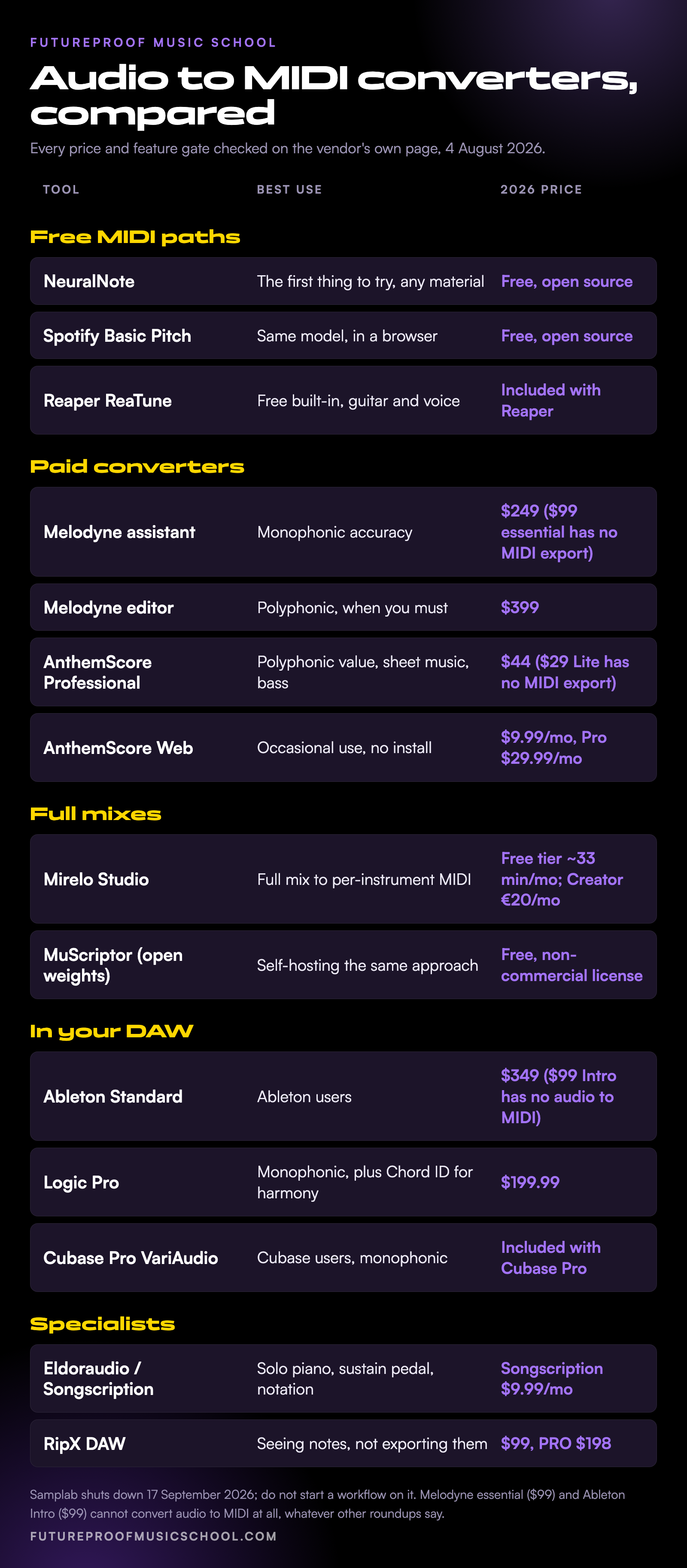
Audio to MIDI tools compared (2026 pricing)

Tool Best for Price (verified 4 Aug 2026)
NeuralNote The first thing to try, any material Free, open source
Spotify Basic Pitch Same model, in a browser Free, open source
Mirelo Studio Full mixes to per-instrument MIDI Free tier ~33 min/mo (watermarked); Creator €20/mo; Studio €99/mo
MuScriptor (open weights) Self-hosting the same approach Free, but CC-BY-NC, non-commercial only
Melodyne assistant Monophonic accuracy $249 (essential at $99 has no MIDI export)
Melodyne editor Polyphonic, when you must $399
AnthemScore Professional Polyphonic, sheet music, bass $44 (Lite at $29 has no MIDI export)
AnthemScore Web Occasional use, no install $9.99/mo, Pro $29.99/mo
Ableton Standard Ableton users $349 (Intro at $99 has no audio to MIDI)
Logic Pro Monophonic plus Chord ID for harmony $199.99, or $12.99/mo Creator Studio
Cubase Pro VariAudio Cubase users, monophonic Included with Cubase Pro
Reaper ReaTune Free, built in Included with Reaper
RipX DAW Seeing notes, not exporting them $99, PRO $198 (25% off currently)
Klangio Transcription Studio 25+ instruments, notation $19.99/mo, $8.33/mo billed annually
Songscription Plus Solo piano to notation $9.99/mo, $8.33/mo annually
ai-midi.com Pay-as-you-go conversions Free tier 1/week; Basic $9.99/mo
Samplab Nothing, it is shutting down Service ends 17 Sept 2026

Aurally Sound Prism, a new ARA2 entrant, is covered below. We did not verify its price in this cycle and will do so at the November review rather than publish a number we have not checked.

The tool everyone is being sold right now

If you have searched this topic recently you have probably seen Aurally Sound Prism. It deserves a section, not because of the tool, but because of what its coverage shows about this category.

We found six videos promoting Prism, including the largest video in the category at 76,000 views, which opens by disclosing that it is sponsored by the vendor. Others use affiliate or vendor tracking links without disclosure. Against that sits exactly one independent, unsponsored shootout, which tested eleven tools on one identical polyphonic guitar recording and placed Prism third, behind Melodyne and AnthemScore, "because you have to do a lot of corrections on this one."

The community's own verdict is genuinely split, roughly seven positive to three negative, and the negatives are specific and consistent: timing drift. KVR users report results that are "very out of sync at the end," and one flatly says "had some very poor results with Prism. Would not recommend it." Positive reports are equally real, particularly on piano and electric piano.

Our read: Prism is a legitimate tool with a large marketing budget, and the gap between how it is covered and how it performs is a good illustration of why we check the description box before trusting a shootout. A viewer under one of those reviews made the sharpest methodological point available: "the real test is using vocal lines rather than guitar which makes things very much more difficult."

Separating stems first: does it actually help?

Since we published our guide to AI stem separation and vocal removal tools, the obvious question is whether chaining the two works. Split the track, then convert the isolated part.

Producers land around 65/35 in favour, and it is now standard advice in Ableton and Logic threads. But the honest verdict from the most thorough published test is narrower than the enthusiasm suggests: separation makes the separation step great and does not fix the MIDI step. Testing four tools on this chain, all of them separated stems well, then got wonky translating polyphonic material to MIDI.

Two refinements that people report genuinely help, beyond separation alone:

  1. EQ-notch to the target before converting. Put an EQ on the separated stem and narrow it to just the frequency range of the notes you want. It gives the converter less to be confused by.
  2. Convert short sections, not whole songs. Tempo drift over a full track compounds the timing problems that are already this category's weak point.

The combination that genuinely works is separation plus an instrument-specific model, rather than separation plus a general converter. There is one documented case of a separated piano stem that both RipX and Melodyne failed on being handled correctly by a piano-specific model.

This whole section may be about to become a legacy workflow. Everything above describes working around a limitation, that converters cannot tell instruments apart, by removing the other instruments first. Mirelo's model attacks that limitation directly, taking the full mix and returning labelled per-instrument MIDI in one step. If it holds up, separate-then-convert stops being best practice and becomes the fallback for material Mirelo handles badly.

For now, both are worth knowing. The stem-first chain is proven, well documented and works with tools you may already own. The full-mix approach is newer, its accuracy is not yet independently verified, and its open model is non-commercial. We will report on which way this settled in the November update.

Drums are a different problem, and a happier one

If you want drums as MIDI, you are not really doing audio to MIDI. You are doing transient detection and drum replacement, which is a more mature technology with far higher satisfaction.

The tools producers actually use here are Superior Drummer 3's Tracker, Slate Trigger 2, XLN Addictive Trigger, Oxford Drum Gate (singled out for sample-accurate MIDI timing), and Massey DRT, whose never-expiring free demo does MIDI export. Ranking between them is genuinely contested.

What everyone agrees on: velocity is the field that comes back broken. Converted drum MIDI frequently arrives with every hit at the same velocity, and humanising it is the actual work.

What producers still argue about

Has this category actually improved, or is it hype? Roughly 60/40 toward yes, in the last twelve months. The strongest evidence for is a VI-Control user re-scoring the same piano piece and getting 5 to 10 percent usable output from Melodyne against 85 to 95 percent from two 2026 tools. The strongest evidence against is a thread of professional transcribers where five of seven said AI output slows them down rather than speeding them up.

Free versus paid. Genuinely unsettled and roughly even. Half say NeuralNote is good enough that Melodyne is not worth hundreds of dollars for this specific job. Half say Melodyne's monophonic accuracy still wins and it does other work too. One producer abandoned a paid trial mid-way: "I found NeuralNote, downloaded in 15 seconds and is free. Works great."

Should you use these at all while learning? A large minority, especially in the piano and music-theory communities, argue actively against it, and their reasoning is worth taking seriously: once you see approximately correct notes on screen, your ears switch off and assume what you are seeing is what you are hearing. The counter-argument is that a rough transcription you then verify by ear is faster than starting from nothing.

We will not pretend to settle that one, but our bias as a school is probably predictable: use it to check your work, not to replace the listening.

Which one should you pick?

  • You have not tried anything yet: NeuralNote. Free, five minutes, and it tells you whether your material is convertible at all.
  • Monophonic lines, accuracy matters, you have budget: Melodyne assistant at $249, or editor at $399 if you also need polyphonic.
  • Polyphonic material, best value: AnthemScore Professional at $44 punches well above its price and beat more expensive tools in the one independent test.
  • Solo piano: a piano-specific model rather than a general converter. Eldoraudio and Songscription both earn real praise here.
  • You want chords rather than individual notes, and use Logic: the Chord Track. It is already installed and most people do not know about it.
  • Drums: a drum replacement tool, not an audio to MIDI converter.
  • Full mixes: try Mirelo's free tier first, since it is the only tool built for this and costs nothing to evaluate. If it struggles on your material, fall back to separating stems, EQ-notching to the part you want, and converting short sections.
  • Anything you intend to release commercially: check the licence, not just the price. The open MuScriptor weights are non-commercial, and the best-performing piano model is academic-licensed too.

What audio to MIDI still can't do

Set expectations before you build a workflow on this. No tool reliably converts dense polyphonic material without substantial correction. Velocity comes back flat almost universally, and Mirelo's model card states outright that it cannot represent dynamics at all. Articulations, slides and expression do not survive the trip, and the most-requested missing feature across every forum is MPE or pitch-bend output for slides, which nothing does well. Instrument assignment from a full mix is now being attempted rather than solved. And converting MIDI onward into readable sheet music is a second unsolved problem, not a formality.

The workflows that succeed treat conversion as a first draft. The most common description of a good result, across a decade of forum posts, is that it gets you in the ballpark.

Which is genuinely useful, and worth being clear about, because the most common real-world use case in the comment sections is not production cleanup at all. It is the wrong-instrument problem. One producer's version: "I suck at organ playing but I can play guitar. I played my killer solo on guitar, converted that to midi and my organ solo was amazing." Another, with 51 likes: "This looks like a godsend to someone with a musical ear but no theory knowledge. I've recorded so many ideas as voice memos and never get round to making them into anything because I'm lost in front of a piano."

That is the honest promise of this technology in 2026. Not a transcription robot, but a bridge between the instrument you play and the one you hear in your head.

If you like tools that do one job well, we build a set of free apps in the same spirit. Mix Assistant tells you what to fix once your parts are down, Primer teaches synthesis by ear, Genre Explorer breaks down how genres are actually built, and Track ID works out what is in a record you like. All free, all in the browser. Our AI mixing and mastering guide covers the other end of this same pipeline.

Frequently Asked Questions

What is the best free audio to MIDI converter?
NeuralNote, a free open-source plugin built on Spotify's Basic Pitch model. It runs inside your DAW, handles polyphonic material, and across producer forums it is the default free recommendation by a wide margin. Two things to know: it exports at 120 BPM by default, so set your tempo afterward, and it applies pitch bends you may want to strip. Basic Pitch's browser version does the same job with nothing to install.
Can Melodyne convert audio to MIDI?
Yes, but not the $99 edition. Melodyne essential has no MIDI export at all. Assistant at $249 exports MIDI from monophonic material, and editor at $399 adds polyphonic DNA, which is what you need for chords. Many guides list Melodyne at $99 in an audio to MIDI context, which is wrong on both counts. There is a full 30-day trial, so test before buying.
Why is polyphonic audio to MIDI so inaccurate?
Because a single note contains harmonics that look identical to other notes. Play A3 and you also produce energy at A4 and E5, so an algorithm genuinely cannot tell one note with harmonics from three separate notes. Reverb tails make note endings ambiguous on top of that. It is a hard problem rather than a neglected one, which is why every tool struggles and why pitch is usually right while timing and velocity are usually wrong.
Does splitting stems first improve audio to MIDI results?
It helps, and it is now standard advice, but less than people expect. Separation works well; the MIDI conversion step is still the bottleneck. Two things measurably improve results beyond separation alone: EQ-notch the stem to the frequency range of the part you want before converting, and convert short sections rather than whole tracks so timing does not drift.
What is the best way to get drums as MIDI?
Use a drum replacement tool rather than an audio to MIDI converter. Superior Drummer's Tracker, Slate Trigger 2, XLN Addictive Trigger and Oxford Drum Gate all work on transient detection, which is a much more reliable approach than pitch detection. Avoid Ableton's Convert Drums for anything detailed: it maps everything to just kick, snare and hi-hat, so cymbals become hi-hats and toms become kicks.

What changed in this update

  • August 2026. First publication. Built on aggregated community evidence rather than vendor documentation, with all pricing and feature gating verified against vendor pages on 4 August 2026. Flagged two widely repeated errors: Melodyne essential and Ableton Intro are both routinely presented as cheap entry points to audio to MIDI, and neither can do it. Documented Samplab's shutdown, which breaks a number of tutorials still ranking for this topic. Added Mirelo and the open MuScriptor model, released July 2026, which is the first serious attempt at full-mix to per-instrument MIDI and which may make the stem-separate-first workflow obsolete. Its accuracy is not yet independently verified and is a priority for the November review.

Sources

Everything above traces to the sources below, read between 2022 and August 2026 and weighted toward the most recent twelve months. Pricing pages were checked on 4 August 2026.

Producer and engineer discussions

Video comparisons (sponsorship noted, because it matters)

Vendor pages, all read 4 August 2026

John von Seggern

John von Seggern

Founder & CEO, Futureproof Music School

John von Seggern is the founder and CEO of Futureproof Music School. He holds an MA in digital ethnomusicology (the anthropology of music on the internet) from UC Riverside, and a BA in Music, magna cum laude, from Carleton College. A techno producer and DJ since the late 1990s, he released as John von on his own net.label Xeriscape Records while working at Native Instruments, where he co-authored the MASSIVE synth manual. He contributed sound design to Pixar's WALL-E (2008), was a member of Jon Hassell's late-career Studio Group on Hassell's final two albums, ran Icon Collective's online program with Max Pote for eight years before Icon closed in May 2025, and authored three books on music technology including Laptop Music Power!. He architected Kadence, the AI music coach at the core of Futureproof.

Ready to level up your production?

Join Futureproof for live mentorship, AI coaching, and a community of producers.

Start your 14-day free trial