Reese Bass Sound Design: Everything You Need to Know

Marketing Director & Bass Music Mentor
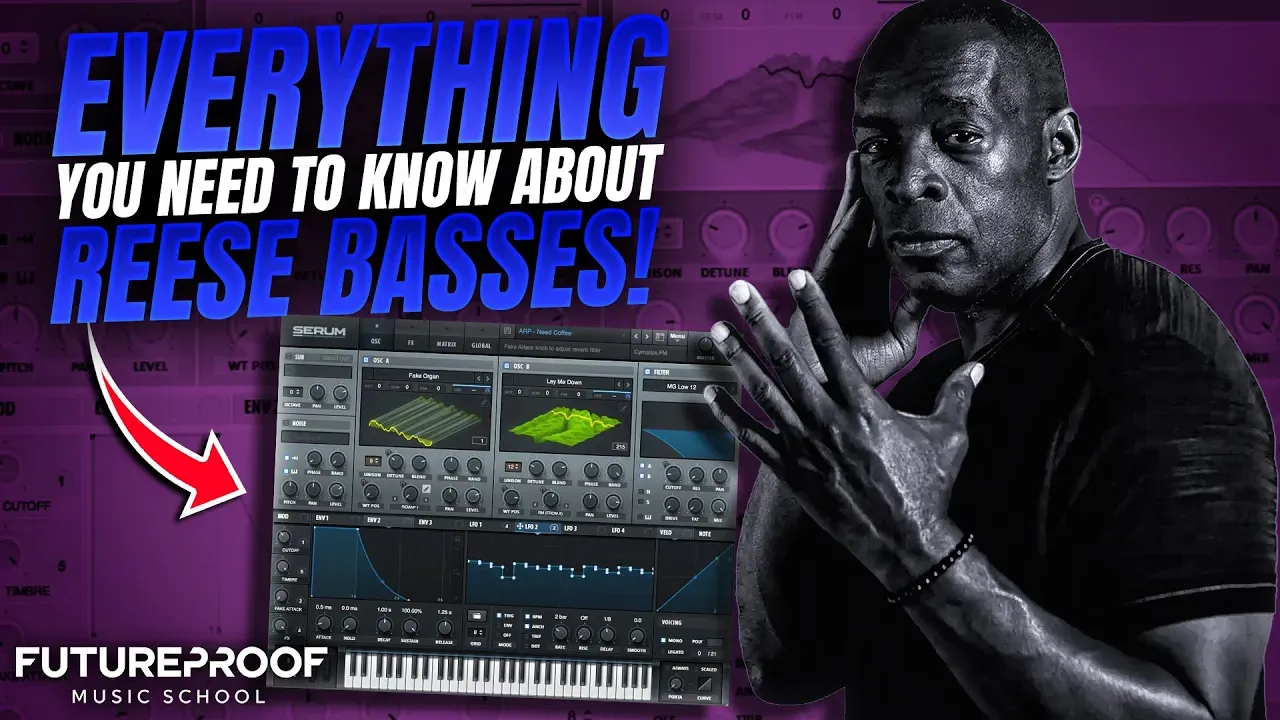
Bass is the other most important element in drum and bass. Across every subgenre there are a few commonalities all the basses share: punchy heavy subs, drop subs, or 808 style basses that really punch and crunch. And then there's probably the most iconic bass of all drum and bass basses, the Reese. Here's where it came from, what actually makes a bass a Reese, and how to build one from scratch.
Watch the Video
Prefer reading? Here's the full breakdown.
What actually makes a Reese a Reese
Even if you're new to drum and bass, you've probably heard of a Reese bass. It's kind of become a byword for a sustained sawtooth type bass. However, proper Reeses have one commonality among them, and that is the fact that there is phase beating that accelerates as the bass gets higher in pitch.
A little history
The first appearance of the Reese bass as we know it was in 1988. A producer named Kevin Saunderson, who was using the artist name Reese at the time, put out a song called "Just Another Chance." He made a bass on it using a Casio CZ series phase distortion synthesizer, a budget version of a Yamaha DX7 that Casio had put out at the time. It used their version of FM synthesis, known as phase distortion synthesis. He made this bass using two oscillators slightly detuned from each other, and that created this very interesting bass that no one had ever heard before. That's the reason it's called the Reese bass: because "Reese, Just Another Chance" was its first appearance.
Its first permeation into drum and bass, and really what brought it to the forefront, was a producer called Ray Keith. He had heard that song, really liked the bass, figured out how to program it himself, and in 1994 put out a song under his name at the time, Renegade. The song was called "Terrorist." That was the first appearance of the Reese in drum and bass, back in 1994. That tune was an absolute smash, and the Reese started being used over and over again in different permutations all throughout drum and bass. That continues to this day.
Building a basic Reese in Vital
For this we're going to be using Vital. You can use literally any synthesizer that has basic shape oscillator waveforms, because all you need is a pair of saws.
First, some setup:
- Set the voicing to Mono.
- Add a little bit of Glide. This is optional, but it's something I always like to add in. It gives it a nice little bit of character.
Method 1, two oscillators:
- Start with a basic saw wave.
- Add a second saw wave, and turn the phase randomization down so they start at the exact same point. At this point it just sounds like a louder version of the single saw oscillator.
- To turn it from a stacked saw oscillator into a Reese, use the fine detune to detune one of the saws.
Now you can hear that phase beating. If I hold a sustained note low and go up in pitch, that phase beating, which is the cancellation between the offset pitch of those two saw waves, speeds up. There are certain points where, as the detuned parts cross over in phase, they cancel each other out. That "wub wub wub" you're hearing is actually phase cancellation caused by two 180-degree out-of-phase points within the waveform.
Method 2, a single oscillator:
- Take a single oscillator and put the Unison voices up to two.
- Go into the advanced tab in unison and turn everything to mono, so there is no stereo spread on the Unison.
- Turn the Unison detune down until you get the exact amount of beating you want.
You can increase or decrease the amount of phase beating just by detuning it slightly more. The amount of detune affects how fast it beats, which is also why, when you go up the keyboard, it beats faster: it's oscillating faster, so it detunes faster.
The traditional Reese is just two detuned saws, but you can use any shape
A traditional sounding Reese is just two detuned saw waves, but you can really make it with any shape you want. Two squared signs, a triangle, even a square wave. I like using saws because it gives you all of the harmonics available to work with. You can turn that saw into essentially anything: a filtered-out low-pass Reese, a screaming Reese, even a notched-out Reese.
Where you'll use it
That is the quintessential Reese, and it's an important one to understand, because you see it absolutely everywhere. Its usefulness across all sorts of subgenres can't be overstated:
- Liquid drum and bass: a much more low-pass version.
- Heavy, hard neurofunk: big, raw, burly Reeses.
- Funk: filtered shots.
There's not a subgenre of drum and bass that doesn't use the Reese at some point. Get comfortable building one from scratch, then start bending it, because the basic processing here is just the doorway into the more advanced techniques.
Max Pote
Marketing Director & Bass Music Mentor
Max Pote is a professional bass music producer who performs and releases under the name Protohype. He has more than a decade of releases on major bass-music labels (Firepower Records, SMOG, Never Say Die, Rottun, Deadbeats), festival appearances at EDC Las Vegas and Lost Lands, and a feature credit on Tom Morello's 2021 album The Atlas Underground Fire. He was an early Icon Collective alumnus and later returned as an instructor before co-founding Futureproof Music School. He leads marketing at Futureproof and mentors students on sound design, songwriting, and finishing tracks.
Want more Futureproof in your Google results?
Ready to level up your production?
Join Futureproof for live mentorship, AI coaching, and a community of producers.
Start your 14-day free trial