What Is Vaporwave? The Genre's Origins, Sound, and Why It Still Matters

Founder & CEO, Futureproof Music School
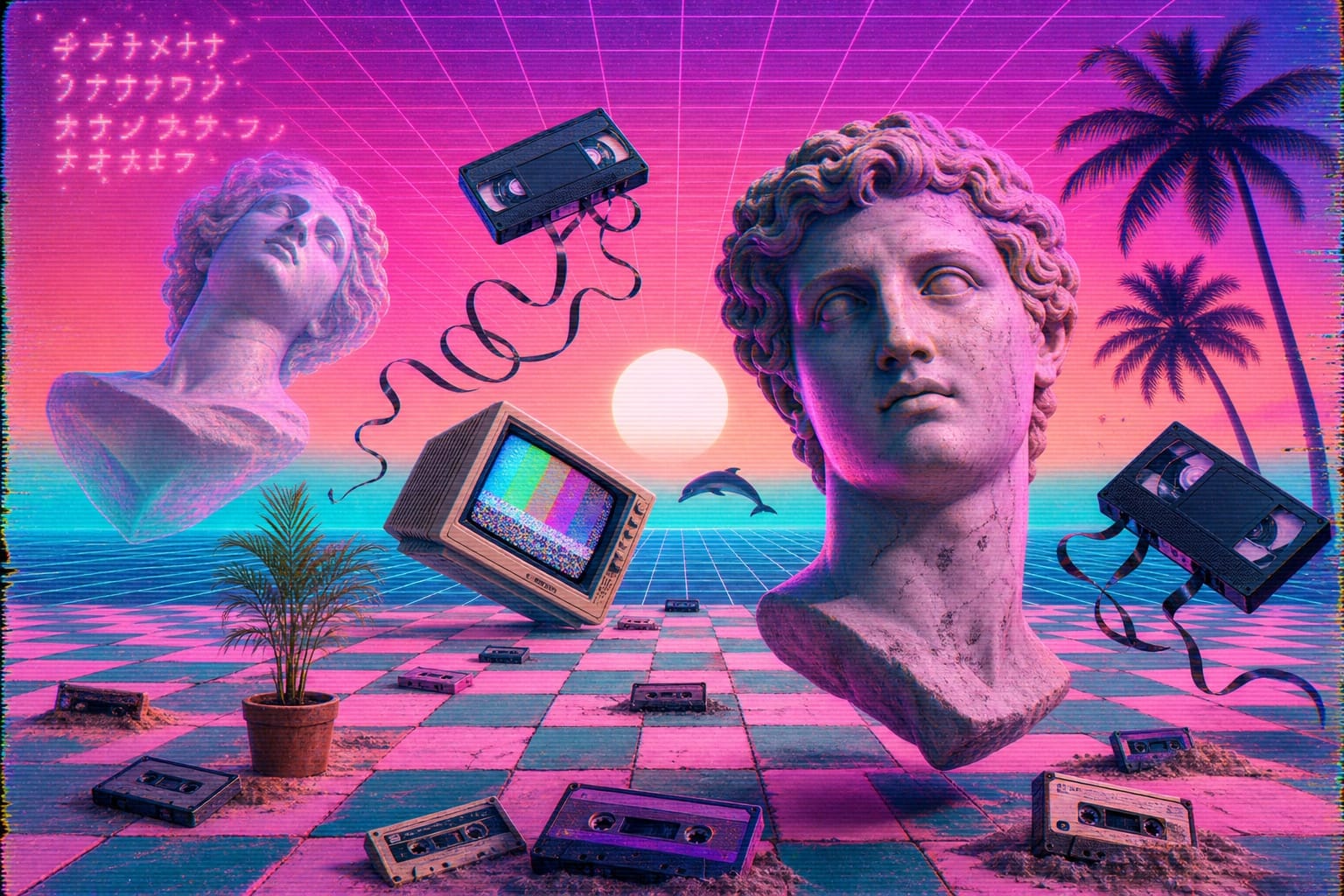
Vaporwave is one of those genres people argue about more than they listen to. Ask ten producers what it is and you'll get ten answers. Some say it's a music genre. Some say it's a visual aesthetic. Some say it's a joke that went too far. They're all a little right.
The way I think of it is this. Vaporwave is a 2010s internet microgenre built on slowed, reverb-soaked samples of 1980s pop, smooth jazz, and corporate Muzak. It uses sound as a way to think about consumerism, nostalgia, and the strange feeling of growing up inside late capitalism. It is also beautiful music if you give it the time to sink in.
This is a genre overview, not a tutorial. If you came here looking for how to make vaporwave, we have a separate guide for that. This post is about where vaporwave came from, what it actually sounds like, and why a genre that looked like a meme in 2012 keeps showing up in 2026.
Where Vaporwave Came From
Vaporwave didn't start with a manifesto. It started with two albums that nobody was sure how to categorize.
The first was Chuck Person's Eccojams Vol. 1, released in 2010. Chuck Person is one of Daniel Lopatin's aliases. (You might know him as Oneohtrix Point Never.) Eccojams is a series of short tracks that take 80s pop songs, slow them down, loop a single phrase, and drown the whole thing in reverb. Toto's "Africa" becomes a five-second meditation that repeats for two minutes. It sounds like a song you half-remember from a dentist's office in 1987.
Chuck Person, Eccojams Vol. 1 (2010). Daniel Lopatin's pre-vaporwave experiment that everyone else built on.
The second was Macintosh Plus's Floral Shoppe in 2011. Macintosh Plus is an alias of Ramona Andra Xavier, who also records as Vektroid. Floral Shoppe took the Eccojams approach further. It pitched down Diana Ross's "It's Your Move" to a slow, syrupy crawl, retitled it in Japanese characters, and put a Roman bust on the cover next to a Windows 95 screenshot. The track "リサフランク420 / 現代のコンピュー" became the song everyone points to when they want to explain what vaporwave is.
Macintosh Plus, "Lisa Frank 420 / Modern Computing" from Floral Shoppe (2011). The track that defined the genre.
By 2012 it had a name. By 2013 it had a Tumblr aesthetic, a Bandcamp scene, and a backlash. The whole arc from obscure experiment to oversaturated meme took about three years.
What Vaporwave Sounds Like
If you strip away the aesthetic for a minute and just listen, vaporwave has a few consistent musical signatures.
It's slow. Most vaporwave sits between 60 and 90 BPM, which is usually the source material slowed 20 to 40 percent from its original tempo. A 134 BPM smooth jazz track pitched down to 106 BPM is canonical. The slowdown is the point. It pulls the music out of its original context and into something dreamier and stranger.
It's drenched in reverb. Plate reverb, hall reverb, anything that adds a sense of empty architectural space. The reverb is doing the work of making a 30-second loop feel like a place you could walk around in.
It loops. Vaporwave producers rarely compose original melodies. They find a phrase in a sample they like and let it repeat until it stops feeling like a song and starts feeling like a memory. The repetition is meditative if you let it be. It's irritating if you don't.
It samples obvious sources on purpose. Diana Ross, Sade, Toto, Sade again, every soft-rock and smooth jazz hit from 1982 to 1989, plus huge amounts of Japanese city pop, corporate training videos, mall ambience recordings, and Muzak compilations. The choice of source material matters as much as (or more than) the production.
Vaporwave is more about sound selection than composition. The samples carry the song; the producer is a curator first and a composer second.
The classic instrument palette behind the samples is the Yamaha DX7 (FM electric piano, the sound of every 80s ballad), the Roland Juno-60 or Juno-106 (warm analog pads), and drum machines like the Linn LM-1 or Roland TR-808. Modern producers cover all of these in software with plugins like Dexed (free DX7), TAL-U-NO-LX (Juno-60), and Arturia V Collection.
Key Artists Who Defined the Sound
A short list of the artists who shaped what vaporwave became.
Daniel Lopatin (Chuck Person, Oneohtrix Point Never). The Eccojams tapes are the foundation. Lopatin moved on to a wider experimental career, including the score for Uncut Gems, but the slowed-sample technique he prototyped here is the genre's DNA.
Ramona Xavier (Macintosh Plus, Vektroid, New Dreams Ltd., 情報デスクVIRTUAL). Xavier ran multiple aliases simultaneously and pushed vaporwave in different directions with each one. Floral Shoppe is the canonical entry point but her Information Desk releases under 情報デスクVIRTUAL are equally important.
James Ferraro. Far Side Virtual (2011) is the conceptual cousin of Floral Shoppe. Where Xavier slowed existing music, Ferraro composed original tracks in the style of corporate hold music. Same critique, different method.
James Ferraro, Far Side Virtual (2011). Corporate Muzak as found-object art.
Saint Pepsi (now Skylar Spence). Saint Pepsi's Hit Vibes (2013) pushed vaporwave's tempo and energy up and effectively launched the Future Funk subgenre. "Enjoy Yourself" is the track that proved you could make people dance to chopped disco loops.
Saint Pepsi, "Enjoy Yourself" (2013). The Future Funk template: chopped disco loops at 110 BPM.
2814. A collaboration between t e l e p a t h テレパシー能力者 and HKE. Their album 新しい日の誕生 (Birth of a New Day, 2015) is the high point of the ambient end of the spectrum. Long, drifting tracks, almost no rhythm, deep nostalgic atmosphere. If you find regular vaporwave too cluttered, start here.
The Subgenres
By 2013 vaporwave had already split into a dozen subgenres. The five that stuck:
Mallsoft. Vaporwave that imagines you're walking through an empty shopping mall after closing. Long ambient tracks, distant reverb, occasional crowd noise.猫 シ Corp. ("Cat System Corp.") is the canonical mallsoft artist. Listen for tape hiss, food court echo, and a complete absence of urgency.
Future Funk. The danceable wing. Faster tempos (100-120 BPM), chopped 70s and 80s disco and Japanese city pop, four-on-the-floor kick patterns. Saint Pepsi started it. Macross 82-99 and Yung Bae kept it alive. If you've heard "vaporwave" in a TikTok video, it was probably Future Funk.
Vaportrap. Vaporwave aesthetics applied to trap drum patterns. 808 sub bass, hi-hat rolls, but with the slowed sample loops and reverb wash on top. A niche but real subgenre. Yung Lean's early work touches this territory.
Hardvapour. The aggressive backlash subgenre. Distorted, fast, industrial. Reacts against vaporwave's pastel softness with something deliberately harsh. Sandtimer and Wosted built the scene. It barely sounds like vaporwave but it's the same community arguing with itself.
Signalwave (broken transmission). Vaporwave made from broadcast television samples instead of music. Jingles, station IDs, weather reports, commercials. Sounds like channel surfing through 1991. The most conceptual end of the spectrum.
The Aesthetic Beyond the Music
You can't really talk about vaporwave without talking about the visuals. The genre developed a visual language as specific as its sound: Roman busts, palm trees, pink and teal gradients, Windows 95 dialog boxes, dolphins, Japanese characters, vintage Pepsi logos, dead malls, low-poly 3D renderings.
The reason this matters for music people is that the aesthetic isn't decoration. The visuals and the sound are doing the same job. Both are made of recycled corporate imagery from the 80s and early 90s. Both are quoting a cultural moment without endorsing it. Both treat consumer culture as something to look at the way an anthropologist looks at a foreign society.
This is why vaporwave gets called a "genre about consumerism" even though almost no vaporwave songs have lyrics. The samples carry the politics. A track built from a 1986 American Express commercial is making an argument before anyone says anything.
Why Vaporwave Still Matters in 2026
A lot of people wrote vaporwave off as a dead meme by 2015. They were wrong. The genre has done what most viral microgenres don't: it survived its own backlash and kept producing serious work for over a decade.
A few reasons it stuck around.
First, the technique transfers. Slowing samples, drowning them in reverb, and looping a single phrase is a technique you can apply to any source material. The mood it produces (nostalgia, suspension, melancholy) is a mood lots of people want to access. Lo-fi hip hop borrowed the production approach. Hyperpop borrowed the maximalist visual language. Even ambient and modern classical producers (William Basinski's Disintegration Loops predates vaporwave but lives in the same neighborhood) share its interest in decay and repetition.
Second, the cultural argument keeps getting more relevant. Vaporwave was making music about late capitalism, digital alienation, and corporate nostalgia in 2011. Those topics did not get less interesting after 2011. Every year that companies sell more polished memories of the 1980s back to us, vaporwave's original critique looks sharper.
Third, the community kept making work. Bandcamp tags like #vaporwave and #mallsoft still get new releases every week. Discord servers and YouTube channels keep the catalog active. The genre is small but it never went dormant. The Plaza, a key vaporwave Bandcamp label, has been releasing consistently for over a decade.
If you want to make vaporwave yourself, the techniques are genuinely beginner-friendly and we have a full guide to the workflow. A free DAW, one good 1980s sample, and a reverb plugin will get you 80 percent of the way there.
Frequently Asked Questions
Is vaporwave still alive?
Who started vaporwave?
What's the difference between vaporwave and synthwave?
Is vaporwave the same as lo-fi?
Why is vaporwave so slow?
John von Seggern
Founder & CEO, Futureproof Music School
John von Seggern is the founder and CEO of Futureproof Music School. He holds an MA in digital ethnomusicology (the anthropology of music on the internet) from UC Riverside, and a BA in Music, magna cum laude, from Carleton College. A techno producer and DJ since the late 1990s, he released as John von on his own net.label Xeriscape Records while working at Native Instruments, where he co-authored the MASSIVE synth manual. He contributed sound design to Pixar's WALL-E (2008), was a member of Jon Hassell's late-career Studio Group on Hassell's final two albums, ran Icon Collective's online program with Max Pote for eight years before Icon closed in May 2025, and authored three books on music technology including Laptop Music Power!. He architected Kadence, the AI music coach at the core of Futureproof.
Want more Futureproof in your Google results?
Ready to level up your production?
Join Futureproof for live mentorship, AI coaching, and a community of producers.
Start your 14-day free trial